"That's Not a Beer Belly. That's Liver Failure Wearing a T-Shirt."
- Why a Pennsylvania Hepatologist Says 87% of Men Over 50 Have It
Backwards About Their Gut
A new look at the "Choline Famine" - the missing nutrient your
grandfather ate every Sunday, the one your doctor was never taught
about in medical school, and why it may be the real reason your
belly won't budge no matter what you do.
Written by Daniel Mercer | Health Desk
Medically reviewed by Dr. Alan Mercer, D.O. - Board Certified
in Integrative Medicine
Updated 2025
| 247,831 👁 views
Robert Hensley was 62 years old the morning he stood in front of
the bathroom mirror in his house outside Pittsburgh and finally
said it out loud.
"Something is wrong with me."
He didn't say it because of the belly, though the belly was the
obvious part. It poked out hard above his belt,
tight as a basketball,
the kind of gut that doesn't jiggle when you tap it. He didn't say
it because of the fatigue, though the fatigue had been with him
for a decade - the kind that coffee couldn't touch, the kind that
put him on the couch by 7 PM whether he wanted to be there or not.
He said it because of what he had read on his phone the night
before, at 2:47 AM, after he couldn't sleep.
He had typed into Google: "why is my belly so big but the rest of
me is skinny?"
The first result that came up was a Mayo Clinic page about
something called NAFLD. Non-alcoholic fatty liver disease. He
scrolled. He read words he had never heard before. Hepatic
steatosis. Fibrosis. Cirrhosis. Liver cancer. Transplant list. He
read that 30 to 38 percent of all adults globally have it. He read
that mortality from this disease in men his age had been climbing
roughly 10% every single year since 1999.
He read that most people with it don't know they have it.
Then he read this sentence, and he put his phone down on the
nightstand and didn't pick it back up.
"The liver is the body's primary fat-burning organ. When it stops
working properly, the fat accumulates - often visible as a hard,
distended upper abdomen that does not respond to diet or
exercise."
Robert looked down at his stomach in the bathroom mirror.
A hard, distended upper abdomen.
That was the phrase. That was him.
For 40 years, he had been calling it a beer belly. He drank, on
average, two beers a week. His wife had been telling him for a
decade that he needed to "get in shape." His doctor - a woman 20
years younger than him who he secretly resented - had told him six
months earlier that his liver enzymes were "a little elevated" but
that he should just "watch his weight." She had used the word
"mild." He had heard the word "fine."
Standing there at 5:48 AM, Robert understood for the first time
that what he had been calling a beer belly might be a sick organ
pushing through his skin.
What he didn't know yet was that he was right.
And what he REALLY didn't know was that within nine months,
his liver enzymes would be normal, he would have lost 34
pounds, his doctor would lean forward at her desk and ask him - for the
first time - "Robert, what changed?"
This is what he told her.
THE DIAGNOSIS NOBODY EXPLAINS
If you've been told you have "mild fatty liver" - or you suspect
you might have it, based on the gut, the fatigue, the brain fog,
the way your shirts pull at the buttons - here is what is almost
certainly happening, and what almost no doctor will tell you in a
12-minute appointment.
You don't have a fat problem. You have a liver problem that
creates a fat problem.
That distinction matters more than anything else you will read
this year. Because if you believe you have a fat problem, you will
spend the next decade doing what every doctor and every magazine
and every influencer tells you to do: eat less, exercise more,
"make better choices," maybe try keto, maybe try Ozempic. And the
belly will not go away. And eventually, you will give up and
decide that this is just what 60 looks like.
It is not what 60 looks like.
It is what a starving liver looks like.
To understand why, you need to understand one thing about the
human liver - the single fact that, once you grasp it, changes the
way you look at your own body in the mirror forever.
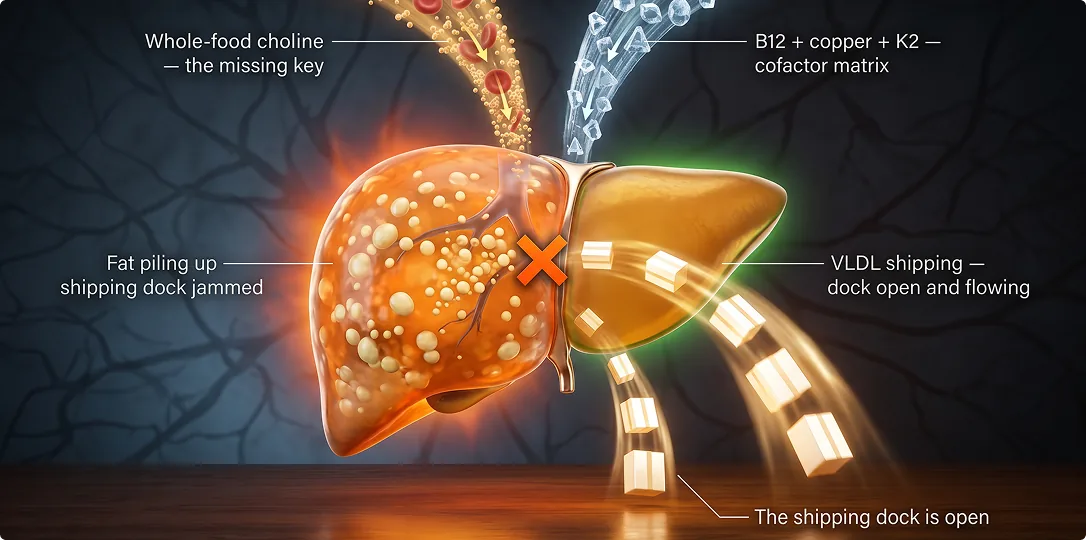
Your liver is a shipping dock.
Every meal you eat, fat shows up at the dock in big trucks -
delivered by your digestive system. Your liver's job is to
repackage that fat into small boxes (technically called VLDL
particles, or "very-low-density lipoproteins") and ship them back
out into the bloodstream, where they get used for energy or stored
for later in the rest of your body.
Healthy liver = open shipping dock.
Fat comes in. Fat goes out. The system flows.
Sick liver = jammed shipping dock.
Fat comes in. Fat doesn't go out. The fat piles up inside the
liver itself. The liver swells. It hardens. It pushes against your
stomach wall and against your diaphragm. Your belly grows from the
inside out - not because you're "fat," but because there is a
swollen, fat-clogged organ behind your skin pushing everything
forward.
That is the hard, round, upper-belly bulge that doesn't go away no
matter what you do.
That is fatty liver disease.
And here is the question almost no doctor will answer for you:
What jams the shipping dock?
THE CHOLINE FAMINE
Dr. Steven Zeisel is a name you have probably never heard. He is
one of the most decorated nutrition scientists in America - a
Harvard-trained MD/PhD who runs the Nutrition Research Institute
at the University of North Carolina, Chapel Hill. He is the man
who, in the late 1990s, convinced the Institute of Medicine to
officially classify a nutrient called choline as essential for
human life.
Read that again.
Essential. Meaning: your
body cannot make enough of it on its own. You must eat it.
Choline was not classified as essential until 1998. To put that in
perspective: the polio vaccine is older than the recognition that
choline is essential to keep your liver alive. The average
American doctor practicing today - including the one who told you
to "watch your weight" - went to medical school before choline was
officially recognized as a nutrient that humans require.
That is not their fault. The average U.S. medical school dedicates
fewer than 20 hours of total instruction to nutrition across four
years of training. Twenty hours. Over four years. Many devote
less.
Here is what Zeisel and his team proved, in a series of controlled
human trials conducted at UNC and replicated by other labs:
When they took healthy adult volunteers - normal weight, normal
labs, no liver issues - and put them on a diet that was
deliberately low in choline, the majority of them developed fatty
liver disease within weeks. Their liver enzymes (ALT specifically)
climbed past twice the upper limit of normal. Their livers, on
scans, accumulated visible fat.
Then Zeisel did something even more revealing.
He put the choline back into the diet.
And the fatty liver reversed.
Read that again, slowly.
Dietary choline deficiency caused fatty liver in healthy
adults. Restoring dietary choline reversed it.
This is not a fringe finding. This is published in the American
Journal of Clinical Nutrition. It is cited in the National
Institutes of Health Office of Dietary Supplements official fact
sheet on choline. It is cited by the Linus Pauling Institute and
by Harvard's T.H. Chan School of Public Health. It is, in
nutrition science, settled.
So the question becomes: how much choline are Americans actually
getting?
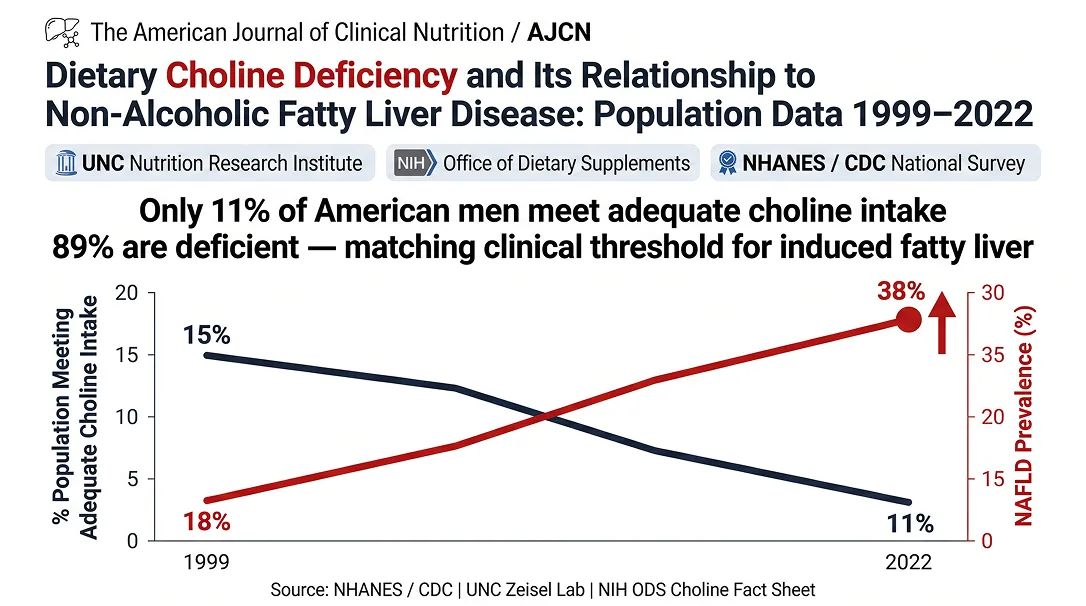
According to NHANES - the National Health and Nutrition
Examination Survey, the largest dietary tracking system in the
United States, run by the CDC - only 11% of men and 6% of women in
America meet the recommended Adequate Intake for choline.
Let that number land.
Eighty-nine percent of American men are choline
deficient.
Ninety-four percent of American women.
Translated into the framework of Zeisel's research: the vast
majority of American adults are eating exactly the kind of diet
that, in controlled clinical trials, has been proven to cause
fatty liver disease.
This is the Choline Famine.
This is what doctors are not taught to look for. This is the
missing piece of the puzzle that connects the rise in fatty liver
disease (now affecting up to 48% of U.S. adults in some samples)
to a specific, measurable, well-documented nutrient deficiency
that is invisible on a routine blood panel because your doctor
isn't testing for it.
And it is also, mercifully, the answer.
If you already know your liver needs choline - if you've been
told you have fatty liver, or you suspect you do based on the
belly, the fatigue, and the brain fog - you don't need to read
the rest of this article. You can skip ahead and see the product
that delivers this nutrient in the form your grandfather ate,
sourced from grass-fed New Zealand cattle:
If you want to understand why every other "fix" you've tried has
failed - and why this one works - keep reading.
WHY YOUR GRANDFATHER DIDN'T HAVE THIS PROBLEM
Here is the part that, when Robert Hensley read it on his phone
six months after that morning in the bathroom, made him sit down
in his recliner and stare at the ceiling for a full half hour.
His grandfather, Harold Hensley - a steelworker from Bethlehem,
Pennsylvania, who lived to 91 - ate liver and onions every single
Sunday of his adult life.
So did most American men born before 1940.
So did most American men born before 1960, for that matter. Organ
meats - liver, kidney, heart, tongue, marrow - were standard.
Cheap, abundant, normal. The "nose to tail" eating that wellness
influencers now call ancestral was, until roughly 1970, simply
called dinner.
Then, somewhere in the 1970s, American eating changed. Organ meats
fell off the table. Muscle meat replaced them. Eggs - another
major source of choline - were demonized by misguided cholesterol
guidelines. Processed grains and seed-oil-fried convenience food
took the place of liver and onions, marrow bones, and farm eggs.
Within a single generation, the American diet went from being
one of the most choline-dense in human history to one of the
most choline-poor.
And within that same generation, fatty liver disease went from a
rare condition affecting alcoholics to a disease that now affects
roughly one in three adults globally.
Robert's grandfather lived to 91 with a flat stomach and a sharp
mind. Robert, at 62, had a basketball belly, fatigue that put him
on the couch by 7 PM, brain fog that made him forget his
daughter's middle name at the dinner table, and a diagnosis his
doctor wouldn't explain.
The difference between the two men was not genetics. Robert and
his grandfather shared most of their DNA.
The difference was choline.
THE BELLY DOESN'T LIE
Here is something that, once you see it, you can't unsee it.
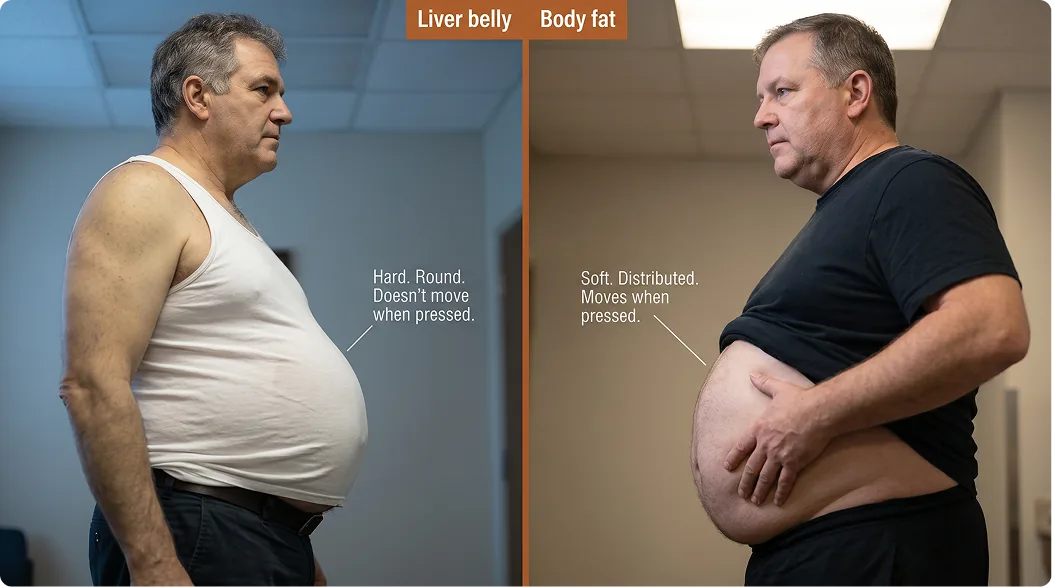
If your belly is hard at the top and softer at the bottom - if you
can grab a handful of soft flesh around your love handles but
the area right under your ribs feels tight, almost
solid, like there's something pushing out from the inside -
that is not body fat behaving normally.
Body fat is soft. Body fat squishes. Body fat moves when you press
it.
The hard upper-belly bulge is something else. It is the silhouette
of your liver, swollen with trapped fat, pressing forward against
the inside of your abdominal wall. It is the shape of an organ in
distress, visible through your skin.
Doctors have a name for this. They call it the "apron belly" or
"central adiposity with hepatic protrusion." Patients have a
simpler name for it. They call it the beer belly.
One name describes a disease. The other describes a moral failing.
Guess which one your doctor uses when she's running 12 minutes
behind on a Tuesday afternoon.
WHY EVERY "FIX" YOU'VE TRIED HAS FAILED
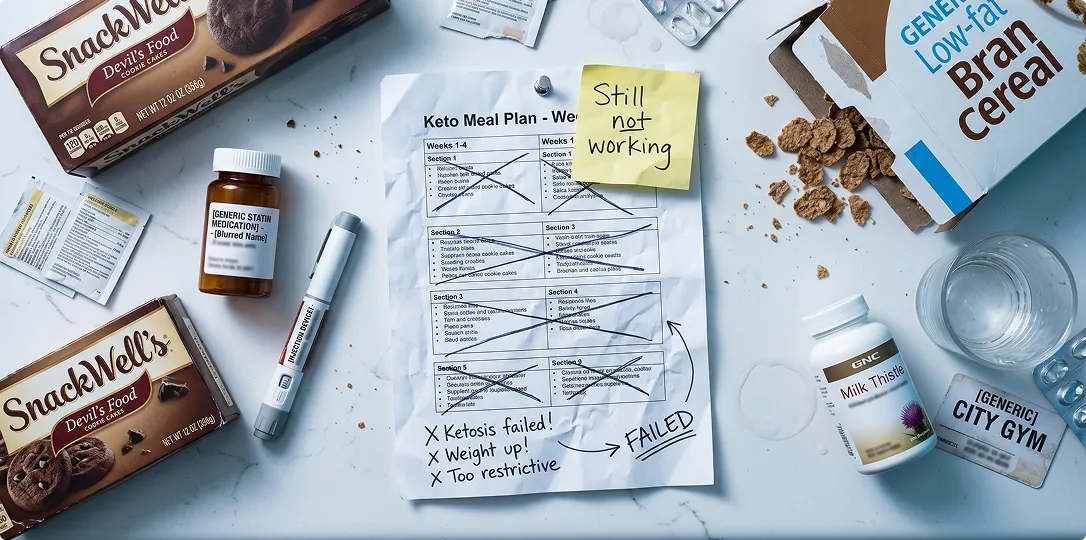
Let's go through the list, because Robert had tried most of it
before that morning in the bathroom, and chances are you have too.
The low-fat diet. He did
it through the 1990s. Bran cereal for breakfast. Skinless chicken
for dinner. SnackWell's cookies for dessert because they had "no
fat." He got fatter every year. Here is why: low-fat diets are
almost always high-carb diets, and excess carbohydrates are
converted by the liver into fat through a process called de novo
lipogenesis. The liver literally manufactures fat from sugar and
stores it in itself. He wasn't eating fat. He was making it.
Cardio. He joined a gym
at 48. Treadmill three times a week. Lost six pounds in two
months. The belly didn't move. He quit. Here is why: exercise
helps mobilize fat from storage. But if the liver can't package
and ship that fat out (because of the missing choline), it just
gets re-deposited. You're shuffling fat around a clogged system.
The fat in the liver stays last because the liver releases it last
- and only when the machinery to release it is intact.
The statin. His doctor
put him on Lipitor at 52. His LDL came down. His belly didn't. His
leg muscles started cramping. His brain felt slower. Here is why:
statins lower the cholesterol number on your lab report by
inhibiting an enzyme in the liver. They do not address the
underlying reason the liver was producing extra cholesterol in the
first place - which, in NAFLD patients, is the same reason it's
storing extra fat: a downstream consequence of phosphatidylcholine
deficiency. The statin treats the symptom (elevated cholesterol
output) and ignores the cause (a liver that can't manufacture
proper lipoproteins).
Ozempic. His neighbor
lost 40 pounds on it. Robert thought about asking his doctor. Then
he saw his neighbor at the Christmas party. Face hollow. Arms
thin. Sitting in a chair the whole night because, the neighbor
admitted quietly, "I feel like garbage. I lost weight but I lost
muscle. My doctor says my liver looks better on the ultrasound but
my testosterone tanked." Here is the truth on GLP-1 drugs and
fatty liver: yes, they reduce liver fat. They do so primarily by
inducing rapid weight loss. The mechanism is not specific to liver
repair - it's specific to caloric restriction enforced by nausea
and delayed gastric emptying. You also lose roughly 25–40% of the
weight as lean muscle. For a 62-year-old man, that muscle does not
come back easily. You end up smaller, weaker, and still
nutritionally deficient.
Rezdiffra. The FDA
approved this in March 2024. It is the first and only drug ever
approved specifically for the inflammatory progression of fatty
liver disease. It costs between $39,600 and $50,100 per year.
Insurance coverage is spotty. You only qualify if you have
biopsy-proven MASH with moderate-to-advanced fibrosis - meaning
you have to already be very sick to get it. Most NAFLD patients
don't qualify. Side effects include diarrhea, nausea, dizziness,
abdominal pain, and itching. The long-term safety profile is
unknown because the drug is less than two years old.
Milk thistle. The
supplement aisle's answer to the liver question for the last 40
years. The active compound, silymarin, has some real research
behind it - at doses of 280 to 800 milligrams per day. The typical
bottle at GNC contains 40 milligrams. Robert took it for three
months. Nothing happened. Here is why: he was taking roughly 5% of
the effective dose. And even at the right dose, milk thistle is a
plant antioxidant - it can help reduce oxidative stress on liver
cells, but it does not supply the structural raw material the
liver needs to package and ship fat. It's polish for the engine.
It's not oil.
Every fix Robert tried failed for the same fundamental reason.
None of them fed the liver the one nutrient it had been starved of
for 40 years.
WHAT ROBERT DID INSTEAD
Six months after the morning in the bathroom, Robert was sitting
in his recliner watching a YouTube video at 9:30 PM when something
caught his attention.
It was an interview with Dr. James Whitaker, a hepatologist who
had spent
22 years treating end-stage liver patients
in a major hospital system before walking away from his hospital
position to focus on what he calls
"the prevention side of the problem."
Dr. Whitaker said something in that interview that Robert wrote
down on a yellow legal pad and stuck to the side of his
refrigerator. It is still there today.
"The American liver is not failing because it is overworked. It is
failing because it is underfed. We have spent 50 years telling men
to eat less of the one food category that contains the nutrients
their liver needs most - and then we act surprised when their
livers stop working."
Whitaker went on to describe the choline famine in detail. He
cited Zeisel. He cited NHANES. He explained the shipping-dock
mechanism. And then he said something that, for Robert, was the
door opening.
"If you want to reverse fatty liver disease without a $40,000
drug, without a surgical biopsy, and without giving up everything
that makes life worth living, you have three options. Eat liver
and onions three times a week, which most of my patients refuse to
do. Eat 10 eggs a day, which most of my patients also refuse. Or
take a high-quality, grass-fed beef organ supplement that delivers
concentrated choline alongside the cofactors - B12, copper,
vitamin A, vitamin K2, heme iron - that the liver actually needs
to use it."
Robert paused the video. Pulled out his phone. Started
researching.
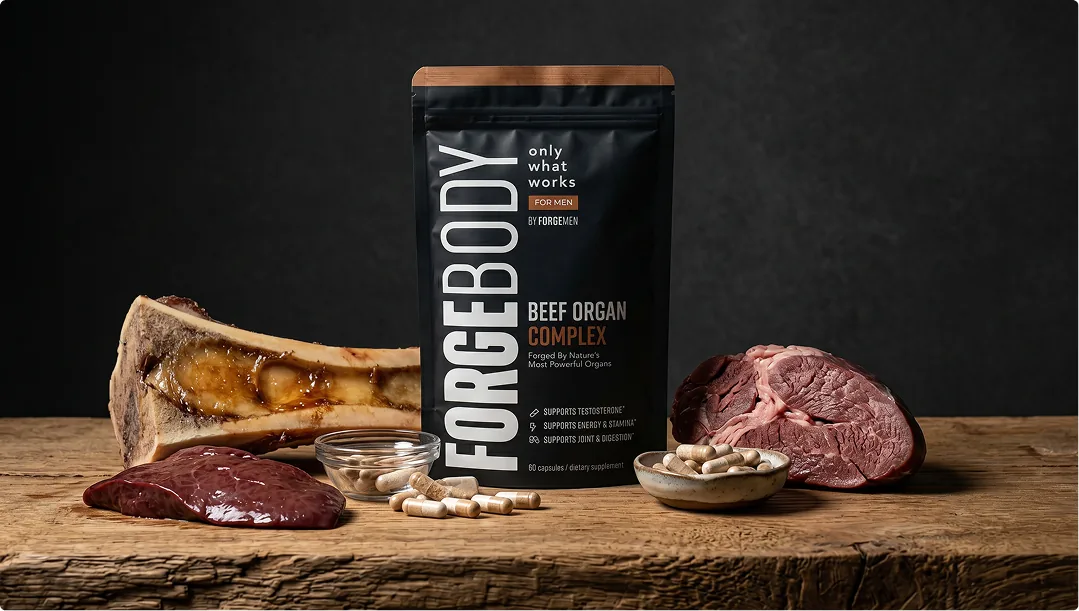
What he found was a product called
Forge Beef Organ Complex.
THE FORGE MECHANISM
Forge is not a supplement in the conventional sense. It does not
contain isolated synthetic vitamins or plant extracts of dubious
dose.
It is, in the most literal sense possible, food in a
capsule.
Specifically:
freeze-dried, grass-fed, grass-finished beef organs
- liver, heart, kidney, pancreas, spleen, bone marrow - sourced
from a small co-op of farms in New Zealand, a country that has
never had a single case of BSE (mad cow disease) and that mandates
pasture-raised, grass-fed cattle as a national standard.
The freeze-drying process
preserves the nutrient content in its native form.
There is no heat. There are no solvents. There is no extraction.
There is no synthesis. The organs are removed, freeze-dried at low
temperature, milled into a fine powder, and encapsulated in a
vegetable capsule that is tasteless and odorless.
Six capsules deliver
roughly 400-500 milligrams of bioavailable choline
- plus the cofactor matrix that distinguishes whole-food choline
from synthetic choline bitartrate. Heme iron at 5-8x the
bioavailability of plant iron. Vitamin B12 in its methylated,
active form. Copper in the ratio nature designed. Preformed
vitamin A (retinol, not beta-carotene). Vitamin K2. CoQ10 from the
heart tissue. Peptides from the marrow.
The food your grandfather ate every Sunday. In a capsule.
Without the smell, the texture, or the gag reflex.
Robert ordered a 90-day supply on a Tuesday. It arrived on a
Friday. He started taking six capsules with breakfast on Saturday
morning.
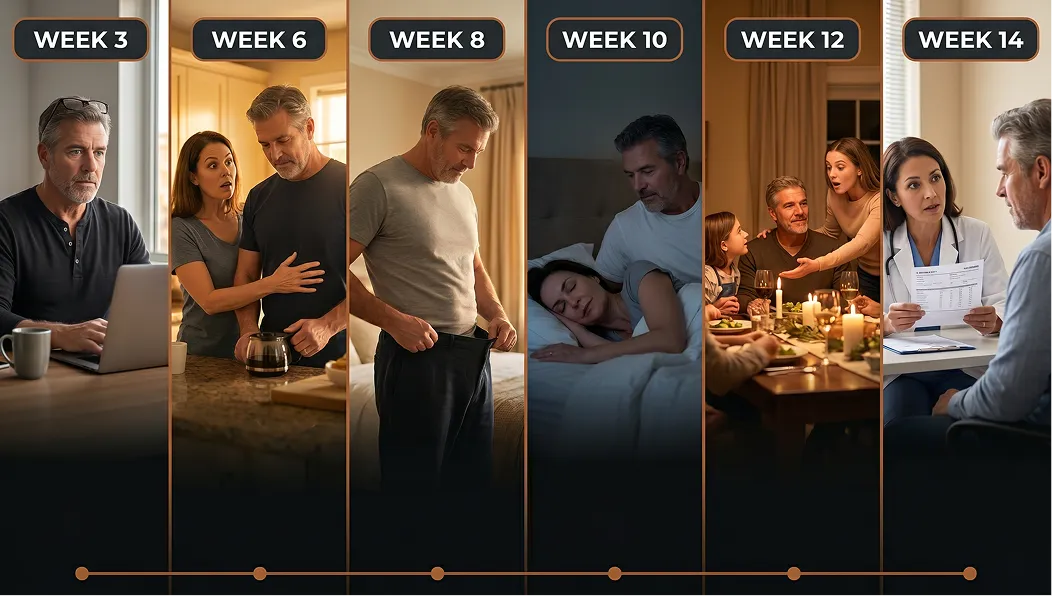
Week 3:
He noticed the 3 PM crash was gone. He sat at his desk at
3:15 one afternoon and realized he wasn't reaching for the
coffee. He wasn't even tired. He stood up and walked outside
just to check that he was actually awake.
Week 6:
His wife came up behind him in the kitchen while he was
making coffee, put her hand flat on his stomach, and said:
"Bob. Is your belly going down?"
Week 8:
His pants were loose.
Week 10:
He stopped snoring.
Week 12:
His daughter looked at him at Sunday dinner and said: "Dad,
your face looks different. What are you doing?"
Week 14:
He went in for his annual physical. He had not told his
doctor anything. He just walked in, gave blood, and waited.
His ALT had dropped from 78 to 31. (Normal range is under 40.)
His AST had dropped from 64 to 28.
His GGT had dropped from 91 to 35.
His triglycerides had dropped from 240 to 118.
His HDL had risen.
His fasting glucose had normalized.
He had lost 27 pounds, almost all of it from his upper abdomen.
His doctor pulled the printout off the screen, looked at him for a
long moment, and asked the question he had been waiting six months
to hear:
"Robert. What changed?"
He told her. He told her about Whitaker, about Zeisel, about the
shipping dock, about the choline famine, about Forge. She
listened. She wrote down the name of the supplement on a Post-it
note and stuck it to the side of her monitor.
When he got to his car in the parking lot, he sat with his hands
on the steering wheel for ten minutes and did not start the
engine. He was not crying. He was just sitting.
He had his life back.
If you want what Robert got - your energy back, your belly down,
your bloodwork normal, your doctor stunned - here is the exact
product he took:
The rest of this article walks through two more transformation
stories, the most common objections, and the pricing details. If
you're ready to start now, click above. If you want the full
picture first, keep reading.
HE IS NOT ALONE
★★★★★
Linda M. - Tucson, AZ
"I'm not bloated. That's the part nobody talks about. I'm
not bloated anymore. I had been bloated since I was 50 and I
didn't even know it wasn't normal. My husband walked behind
me at the grocery store one Tuesday and said, 'Lin, your
back is gorgeous.' I cried in the cereal aisle."
★★★★★
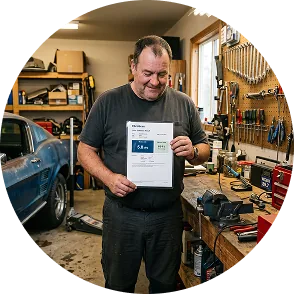
Jim H. - Akron, OH
"My doctor used the word 'pre-cirrhotic'. I started Forge
because my brother told me to. Six weeks in, I wasn't
reaching for the chips at 9 PM anymore. Eighteen weeks in,
my FibroScan dropped from 8.7 to 5.4 kPa. My hepatologist
wrote 'Significant improvement' on my chart. I have that
page laminated in my garage."
Robert. Linda. Jim. Three different ages, three different bodies,
three different starting points - and
the same product, the same mechanism, the same result.
Before you click, read the objections section below. It will save
you a phone call to customer service.
THE OBJECTIONS THAT WILL STOP YOU FROM DOING ANYTHING
If you're like Robert was that morning in the bathroom, you have
already started arguing with this article in your head. That's
normal. That's the part of you that has been disappointed before,
lectured before, lied to before. Let's go through the arguments.
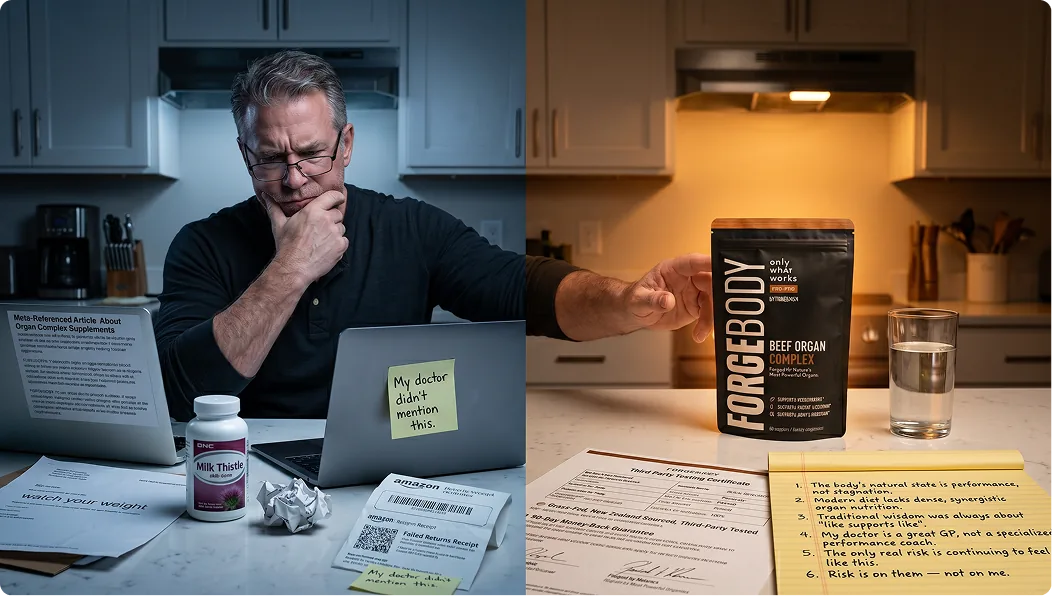
"My doctor didn't tell me about any of this."
Correct. She wasn't taught. The average U.S. medical school
dedicates fewer than 20 hours of total instruction to nutrition
over four years. Choline was not classified as essential until
1998. Your doctor is not lying to you. She is doing her best with
what she was trained on. What she was trained on does not include
this.
"Pills made of cow organs sounds dangerous."
Forge sources from New Zealand, a country with zero cases of BSE
in its history. No high-risk tissues (brain, spinal cord) are
included. The product is third-party tested for heavy metals,
microbial contamination, and purity. It is food. It is, in fact,
safer than the ibuprofen in your medicine cabinet.
"This is going to taste terrible / I'll burp it up."
The capsules are tasteless, odorless, and you swallow them with
water like any other pill. There is no fishy aftertaste. There is
no liver flavor. You will not know they are there.
"I'm 62. The damage is done."
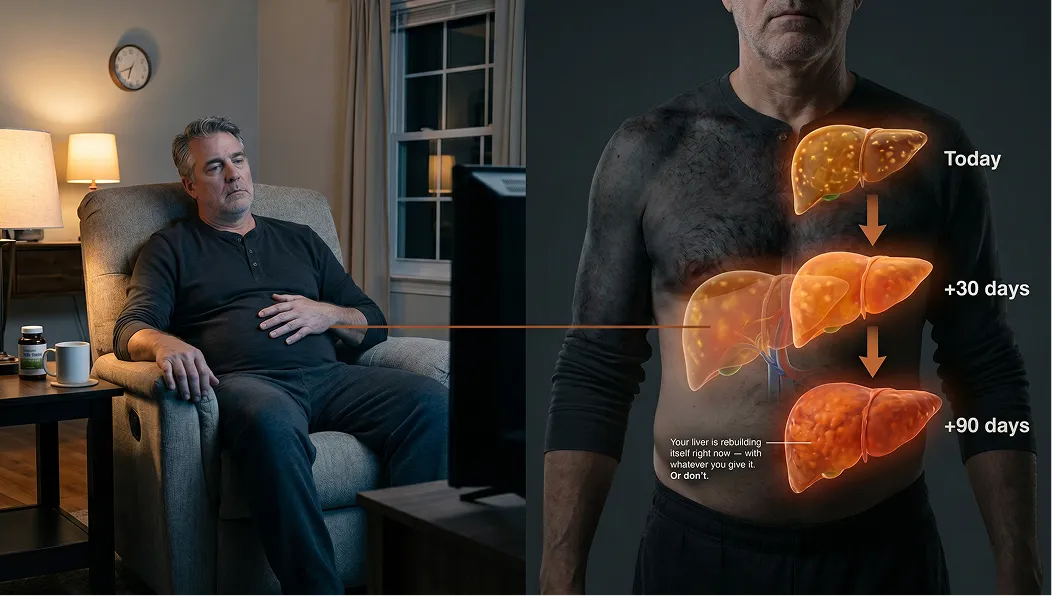
The liver is the only solid organ in the human body that
regenerates by design. Hepatocytes - liver cells - turn over every
150 to 500 days regardless of your age. Your liver does not know
how old you are. It is rebuilding itself right now, with whatever
raw material you give it. The only question is whether you give it
the right material or the wrong material.
"I'd rather just take the real drug."
If you qualify for Rezdiffra - meaning you have biopsy-proven MASH
with moderate-to-advanced fibrosis, and your insurance will cover
the $40,000 annual cost, and you're comfortable with the diarrhea,
nausea, dizziness, and unknown long-term safety profile - then by
all means, ask your doctor. Most NAFLD patients don't qualify.
Most insurance won't cover it. And most patients would prefer to
address the deficiency before it becomes the disease that requires
the drug.
"What if it doesn't work for me?"
Forge offers a 90-day money-back guarantee. Take the capsules for
90 days. If your energy doesn't improve, your belly doesn't
shrink, and your bloodwork doesn't move, send the empty packs back
and they refund every penny. The risk is on them, not on you.
THE REAL MATH ON WHAT THIS COSTS
Let's be honest about money, because the price is going to be the
last thing standing between you and your decision, and you deserve
to see it clearly.
Forge Beef Organ Complex comes in three packages. Here is what
each one actually costs you, broken down to the day:
The 1-Pack Starter -
30-day supply. Comes out to roughly $2.30 per day. This is the
package most first-time buyers reach for. It is also,
mathematically, the worst deal Forge offers. Here is why: a
single pack gets you through the first month - which, based on
the testimonials, is the month where most men notice the 3 PM
crash disappear but have NOT yet seen the belly move. The belly
comes down between weeks 8 and 14. If you order one pack, you're
going to run out exactly when the visible transformation is
starting, and you're going to have to reorder at full price.
The 3-Pack Builder -
90-day supply. Drops the cost per pack by about 20%. This is the
minimum protocol I'd consider if you actually want to see the
belly move. Ninety days gets you through the full liver-cell
turnover cycle. Your hepatocytes regenerate every 150 to 500
days. Three packs puts you halfway through the cycle. You'll see
energy by week 3, mental clarity by week 6, belly reduction by
week 10, and you'll be measurably different on bloodwork by day
90.
The 6-Pack Transformation
- 180-day supply. Drops the cost per pack by roughly 40%
compared to a single pack. Comes out to approximately $1.30 per
day. This is the package Robert ordered. This is the package
Linda ordered. This is the package Jim's brother shipped to his
house. Here is the math: at 180 days, you have completed one
full liver-cell regeneration cycle. Every hepatocyte you have
today will have been replaced by a new one - built from the raw
materials you've been feeding it. This is not a maintenance
dose. This is a structural rebuild.
Now compare those numbers to the alternatives, honestly:
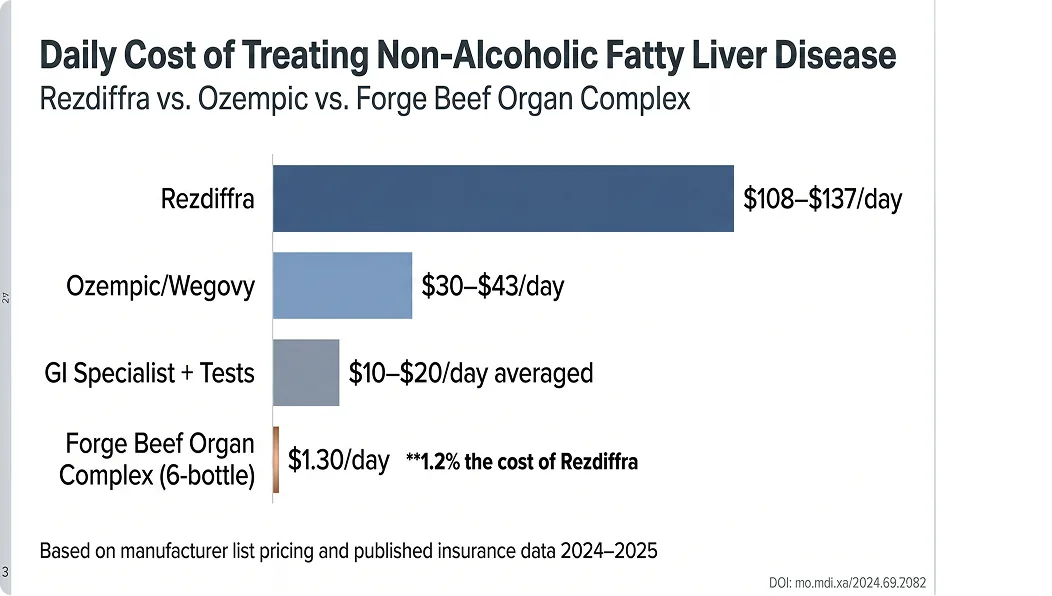
Rezdiffra: $39,600 to
$50,100 per year. That works out to roughly $108 to $137 per
day.
Ozempic / Wegovy: $900
to $1,300 per month out of pocket. Roughly $30 to $43 per day.
A liver specialist visit:
$200 to $500 per visit, before tests, before scans, before
biopsy. A FibroScan alone runs $300 to $700.
A single ER visit for liver-related symptoms:
$2,500 to $8,000 average, before admission.
Forge at $1.30 per day on the 6-pack is roughly 1.2% the cost
of the new fatty liver drug your doctor probably can't even
prescribe to you.
Most men who land on this page choose the 6-pack package. Not
because they're loyalists. Because once they do the math, the
1-pack and 3-pack options stop making sense. The 6-pack is cheaper
per day, it covers a full transformation cycle, it locks in the
founders' pricing for any future reorders, and if it doesn't work,
the 90-day money-back guarantee covers every pack - even the ones
you've already opened.
To be specific: if you order 6 packs and at day 90 your bloodwork
hasn't moved, your belly hasn't shrunk, and your energy hasn't
returned, you ship the packs back (empty, full, half-used, it
doesn't matter) and
Forge refunds every penny.
The risk is on them. The math is on you.
WHAT HAPPENS IF YOU WAIT
Three months from now, the New Zealand co-op will close out the
current slaughter cycle. Forge will be on backorder for roughly 60
to 90 days while the next batch is processed, freeze-dried,
tested, and encapsulated. Founders' pricing will not be honored on
reorders during the backorder window.
That's the supply reality. It's not a fake countdown timer. It's
how seasonal grass-fed sourcing works.
But that's not the real cost of waiting.
The real cost of waiting is biological.
Every day you wait, your liver gets a little fattier.
Every day you wait, the shipping dock gets a little more jammed.
Every day you wait, the belly gets a little harder, the energy
gets a little lower, the brain fog gets a little thicker.
Hepatocytes turn over every 150 to 500 days regardless. Your liver
is rebuilding itself right now - with whatever raw material you
give it, or don't.
Robert waited six months between the morning in the bathroom and
the night he watched Whitaker's interview. He told me the thing he
regrets most is not the 40 years of bad dietary advice he
followed. It's the six months he sat on what he already knew,
hoping it would fix itself.
Don't be Robert at month five.
YOUR THREE OPTIONS
Option 1: Close this tab.
Go back to whatever you were doing. In six months, when your next
blood panel comes back and your ALT is higher, remember that you
read this article and did nothing.
Option 2: Order one pack.
Try it for 30 days. Notice the energy come back. Run out exactly
when the belly is starting to move. Reorder at full price and kick
yourself for not getting the 6-pack.
Option 3: Order the 6-pack transformation package.
Lock in the founders' pricing. Cover a full liver-cell
regeneration cycle. Get your bloodwork redone at day 90 and again
at day 180. Walk into your doctor's office at month 6, hand her
the printout, and watch her face.
That's the morning Robert had. That's the morning Linda had.
That's the morning Jim had.
The button below takes you to the page where you can see all three
packages side by side, view the third-party testing certificates,
see photos of the New Zealand co-op farms, and place your order.
Order the 6-pack. Take six capsules with breakfast every morning.
Give it 180 days.
Then walk into your doctor's office, hand her the printout, and
watch her face.
The only thing standing between you and that moment is the next
click.